Showing posts with label Tolkien. Show all posts

Monday, December 10, 2018

Fall 2018 Convocation - Guest Blogger


Vol 3 No 13

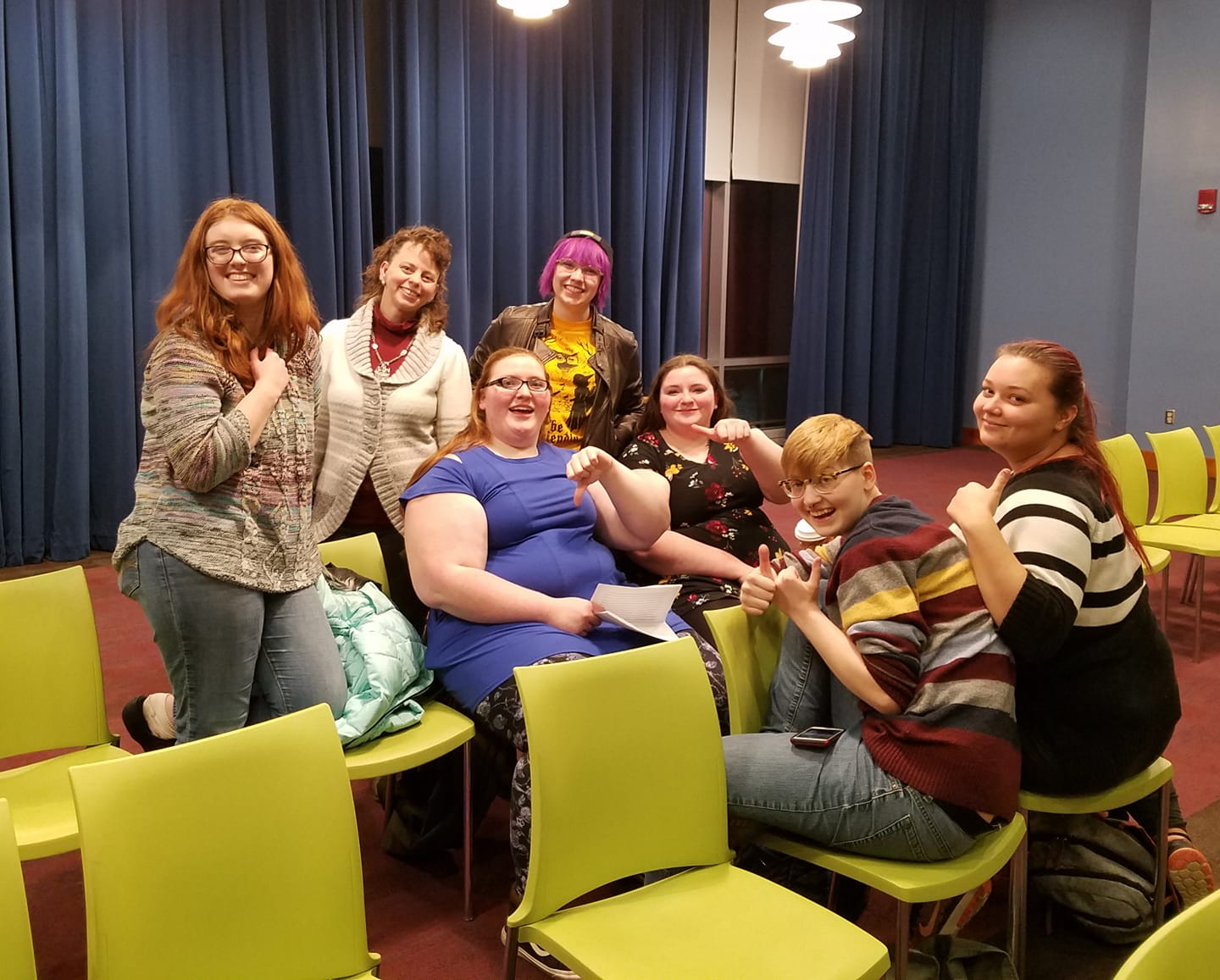
This edition of Honors Matters is brought to us by a guest – not just a guest blogger, but also a guest at the Fall 2018 Honors Studies Convocation.  It is tradition to have the ‘report’ of the event come from someone other than myself.  This way, you get to hear the voice of another who is invested in, and intrigued by, Honors.  I would like to thank those who attended and also those who presented.  You will read more about those presentations below.  I would also like to thank those who made posters for this semester’s Convocation:  Brianna Smith and Bucket Abdallah (Perspectives on Tolkien), Rebeccas Rayne (Math for Liberal Arts Majors), and Persy Woodruff (Games and Storytelling).  Now, without further ado, let us read about the presentations!

Greetings blogosphere,

I am Johnathan Murray, the Director of the One Stop Center here at Finger Lakes Community College.  Like you, I am curious about Honors Studies, and it was this curiosity that prompted me to attend the College’s third Honors Studies Convocation.  The convocation took place on Wednesday, December 5th, and involved five Honors Scholars sharing their experiences with us.  It was an impressive, and moving event.  Each scholar shared an assignment from their course, and with their own unique style and voice, provided us with a window into the honors experience at FLCC.

Lisa Scott was up first, discussing HON 200 – Food and Identity in American Culture.  Lisa shared her experience growing up on a farm, and how it shaped her love of animals, and embrace of vegetarianism.  She showcased a genuine interest and passion for natural foods.

Mela Folan was next, discussing ENG 101 – Composition 1 Honors.  Mela provided an overview of the assignments she worked on in the course, and shared her initial apprehension about taking the course.  She, with the encouragement of her professor, discussed the detailed essay she wrote about smoothies.

Next, was the sister duo of Persy and Luc Woodruff.  Trista introduced the pair as de-facto twins, and noted their proclivity for collaboration.  The sisters shared their experience in HON 200 – Games and Storytelling.  The sisters took turns sharing the Vignettes they created in the course, about their names.  They each told a moving story.

Last, but not least, was Mara Cornwall.  Mara presented on ENG 230 – Perspectives on Tolkien, a course that is on my personal bucket list.  In Mara’s course they watched the classic animated Hobbit film from the 70s.  Visions of a green frog-esque Gollum jumped around in my head, as Mara related a quote from the film to her own experience as an honors scholar.

The Honors Studies Convocation was a wonderful event.  It highlighted the wonderful work of our honors students. 

I hope to see you at the next convocation.  Remember, ‘all you have to be is curious’!

-Johnathan


Friday, September 14, 2018

(Un)Comfortable


Vol 3 No 2

I recently polled my Perspectives on Tolkien class and my Composition I class – both Honors – and asked them to give me one word they thought of when they thought of Honors.  Now, these classes, for the most part, are made of up two different groups of students.  Tolkien is small – just 9 students – and most of them are not new to Honors or to the college.  The other class has 19 and many of them are brand new not just to Honors, but to FLCC altogether.  All of them knew they were signing up for an Honors class, though, so they had heard SOMETHING about it prior to registration.  The Tolkien class each gave me two words because they wanted to not be limited (and I complied).  Here are the compiled words.


Amazing
Uncertainty
Homey
Stressful
Advanced
Fun
Gifted
Outlet
Home
Refreshing
Powerful
Exclusive
Curiosity (appeared twice)
Advanced
Drive
Rad
Freedom
Open-Ended
Unique
Unique
Welcoming
Learning
Terrifying
Extraordinary


Now, part of me wanted to leave a few of those words off the list – like stressful and terrifying – but I knew I couldn’t do that.  And, quite frankly, I’m not sure that I really DO want to leave them off.  They aren’t the most positive words, of course, but they aren’t necessarily as negative as they may appear.  Last year at the National Collegiate Honors Council, I heard someone say something to the effect of “Come in and make yourself uncomfortable” and that has stuck with me.  I’m also reminded of Eleanor Roosevelt’s advice to “do one thing every day that scares you.”  Being challenged and afraid and uncertain do make us terribly vulnerable…but there is something powerful in vulnerability, too.  So, yes, an Honors class may challenge you to face things that scare you – like having to participate in class or not being able to ‘hide’ in the back – but you’ve chosen to do that because you have some of those other things in the list.  You are also amazing and unique and you have a penchant for learning.  You will very quickly learn how welcoming Honors is and how much it can come to feel like home. 

I recently watched a student struggle with some of these concepts even though she was a firm believer in Honors and fully endorses all that it offers.  Folks who know Jill Bond know that she is one of the most prolific delvers into Honors, but it’s not always an easy path even for her.  As part of FLCC’s Women’s Initiative on Leadership, she read Brene Brown’s Daring Greatly:  How the Courage to be Vulnerable Transforms the Way we Live, Love, Parent, and Lead.  She was not a fan of the book at first, even going so far as to say that she “despised and rejected this entire ideology since vulnerability has never quite seemed to work out.”  The more she reflected, however, the more she realized that “Brown was right when she said vulnerability is the key to creativity and inspiration, since the more I shared my work and received feedback on it, the more motivated I was to continue working and striving towards increased skill and ability.”  In the end, she vows to “actively try to be more vulnerable since clearly it is helping in the creation of my own artistic and academic pieces.”  

This is a powerful realization and a testament to what Roosevelt encourages of us.

While I remain committed to curiosity as the cornerstone and tagline of Honors, I wonder if it has two other core concepts.  “Come in and make yourself uncomfortable” may not be the most welcoming of messages, but it is something to realize about Honors.  Being uncomfortable isn’t such a bad thing if you know that you are in a safe place in which to push yourself beyond your comfort zone.  And inviting students to be vulnerable may not encourage them to join us in Honors, but what if they come and find themselves ‘at home’ – then, perhaps, they can feel comfortable enough in their discomfort to reveal who they are and where their passions lie.  After all, our passions are close to our hearts as well as being close to our minds.

Come to Honors and share with us…you might find yourself feeling vulnerable and terrified and stressed – but, more importantly, you will feel welcomed and supported.

Come in and make yourself (un)comfortable.


Monday, March 6, 2017

"I Was a Different Person Then"

Vol. 1 No. 17

I'm teaching an Honors Seminar in Alice and Wonderland this semester and it always amazes me how much the journey of that little girl echoes the experience of Honors, at least metaphorically.  I was also recently reminded about how the word Honors is received sometimes.

Last week I was in a meeting with a member of administration who is also a faculty member and she said something that I think rings true for a lot of people.  In short, she said that the word Honors scares her.  That’s one of the things that I’ve been trying to battle since I took on the mantle of Director.  In the high schools, Honors gets attached to things like the National Honors Society and even at the college level we talk about graduating ‘with Honors.’  All of that leads, of course, to confusion.  Carrying on the defining of things that I started last week, I thought I would do the same thing with the word 'Honors'.  According to the National Collegiate Honors Council, which is a national organization that is centered on Honors, it’s really not about the “smart kids”:

Honors education is characterized by in-class and extracurricular activities that are measurably broader, deeper, or more complex than comparable learning experiences typically found at institutions of higher education. Honors experiences include a distinctive learner-directed environment and philosophy, provide opportunities that are appropriately tailored to fit the institution's culture and mission, and frequently occur within a close community of students and faculty.

As you can see, it’s all about HOW classes are taught and the impact of that methodology rather than the relative intelligence of the individual students.  It’s about making connections (there’s that word again) with the content and with the people who are with you on your learning journey.

Now, it goes without saying that more academically minded students tend to gravitate towards Honors, but it’s also appealing to students because of what is taught and how it is taught.  I’ve encountered so many Honors students who realized that it was something that they had within themselves rather than something they had to bring with them.  Sometimes, it's not about who the student is, but who the student CAN be.

Take the student who fell into ENG 101 Honors with me last semester and came up at the end of the first class to ask if I thought he should stay.  He had only signed up because the time fit his schedule and he didn’t realize it was Honors.  I told him absolutely – the support and camaraderie he would experience would help him succeed.  He ended semester by writing a note in his attendance folder that said, “Thank you – I went from summer school to a 34-page portfolio.”  That made me feel pretty special as an instructor, but it really says more about how powerful the Honors experience can be – and that has as much (or more!) to do with the students and what is built together as it does with what the instructor alone brings.

Or consider the student who signed up for ENG 230 because she wanted to read The Lord of the Rings and is now pursuing Honors recognition.  I recently asked her if she would have believed it had someone told her two years ago that she would be a student of Honors Studies in college and she replied with “No way.  I probably would’ve cried thinking they were mocking me.”

Some seek out Honors.  Some find it by mistake.  Some visit, but then head away again not to return.  Some are changed forever by the experiences they have in their Honors courses.  College really is about finding where you fit and then making the most of the time you have there.  Honors is no different in that regard.  I hope each of you find what you are looking for and for those who find it in Honors, we are glad to have you here.

“Who in the world am I? Ah, that's the great puzzle.” – Alice from Lewis Carroll’s Alice in Wonderland

“This above all: to thine own self be true” – Polonius, in William Shakespeare’s Hamlet

Monday, February 27, 2017

Mirror, Mirror....

Vol 1. No 16

One of the cornerstones of the Honors experiences is the reflection that happens along the way.  We talk about reflection all the time, but for those who are perhaps not familiar with the idea in connection with learning - what does reflection mean?    I mean, we know what a reflection is because we look in mirrors everyday and we comment on things like how beautiful it is when the sun reflects on the surface of a rippling lake.  But what does it really mean?

If we look back in time, we can learn that the word reflection comes from the Latin reflectere, which means "to bend backwards, turn away."  We can see this in our sun on the lake, for the light is bent back upwards from the water; however, that doesn't much help when we think about learning.  It becomes interesting to note that in the 1640's, reflection was understood to mean "remark made after turning back one's thought on some subject" (Read more at the Online Etymology Dictionary).  Now we are getting somewhere!

I've said in a number of Honors Studies talks that we seem to spend a lot of time in academia with disciplines firmly in place - you learn biology over here, and mathematics over there, and then you have English here, and sociology over there.  We are trying, at FLCC, to remove some of these barriers, by showing the interconnectedness of disciplines.  The college challenges students to make connections and Honors is part of that.

Reflection in Honors is about seeing connections in all sorts of ways.  It is the connection between different classes - from those in your program to the electives you chose.  It is the connection between yourself and your classmates and your instructor.  It's the connections between your college experiences and those in other arenas of your life.  It connections between your past, your present, and even your future.  It's thinking about how all of the facets of your life interact at any given moment.  It's turning back your glance to look at yourself and how you learn.  It's about appreciating the powers of your mind and what it can do.  It's about seeing where you fit into your world and where you want to fit.  It's about seeing what your limitations and obstacles are and how you can work on removing those.  In short, it's about better understanding yourself so that you can better understand the world around you.

If this seems like a daunting task, that is because it is.  Honors is not about throwing you into the deep end of the pool and hoping you learn to swim, however.  We want to help you start to make those connections and learn about who you are.  There are so many ways to do this and you'll find the approach to be a little bit different in every Honors class you take.  What you can always expect, however, is writing.  Sometimes at home, sometimes in class, sometimes in a combination activity that spans time spent in the classroom and some time spent elsewhere.  Sometimes you will be asked to go find another place to write and think.  Changing your environment can make a big difference in how you view the class and its content.

To show you what I mean, the following is an activity I use in my Perspectives on Tolkien class.  As you can see, it takes quotes from a shared reading and asks students to think about it - first in connection with the class content and then in relation to their journey as a learner in a larger context.  It makes the suggestion that how readers interact with a text is connected to events in the world around them and the frame of mind with which they approach the text.

What ways have YOU reflected on your learning and your place in the world?

***

First, read these four excerpts from Fuller’s essay:
·         “This is meaning…that the reader translates into appropriate analogies for his own life, if he is so minded:  as in the fact that courage and integrity, seen in any context, are enhancements and encouragements of those qualities wherever we have need of them” (19).

·         “[W]e are confronted basically by a raw struggle between good and evil.  This contest offers a challenge and demands decisions of several kinds.  The power of evil is formidable and ruthless.  The initial decision, in which many of the characters participate, is whether or not to attempt to resist it at all” (19).

·         “The intricacy of Tolkien’s web of cause and effect, of the interactions of motives and wills, natural and supernatural, is extraordinary and – notwithstanding the frame of fantasy – profoundly realistic” (24).

·         “It gives joy, excitement, a lift of spirits, and it contains the kind of wisdom and insight which, if applied to the world we inhabit, might help our sore-beset race to hang on through the present shadows of modern Mordor into yet another age” (30).

Now consider this:
Each of you came to this course with a love of Tolkien’s world, regardless of how you came to encounter it.  Though you have a shared love of the work, it is also true that you are each reading for something different and exploring with your own perspectives, interests, and experiences.  Whether this is your first reading or your hundredth, you are discovering new things and focusing on different aspects right along with celebrating old favorites.  In short, there is something new to be found for each of you.

Finally, write:

Choose a prompt that speaks to your place in the world right now and the frame of mind with which you are reading The Lord of the Rings.   Write a response in which you tie the quote you chose directly to a specific character or event in The Fellowship of the Ring or the first half of The Two Towers.  Then, push it one step further:  find where you fit in.  Why did you pick this quote?  What drew you to that character or scene in Fellowship / Towers?  How does this quote inform your reading of this first half of the trilogy?   How might this quote reflect you, your mindset, and the world in which you find yourself as you read the texts (this time)? 

Article:
Fuller, Edmund.  "The Lord of the Hobbits:  J.R.R. Tolkien."  Understanding the Lord of the Rings:  The Best of Tolkien Criticism.  Ed. Rose A, Zimbardo and Neil D. Isaacs.  Boston:  Houghton Mifflin, 2004.  16-30.  Print.

Saturday, October 1, 2016

Dinosaur Thoughts....

Vol. 1, No. 4

I hand wrote this last evening while having dinner in Syracuse following a pre-retreat gathering with six other Honors Directors from various SUNY schools...

So, I am sitting at Dinosaur BBQ with a brain very full after just two hours of meeting with a (hopefully) comparatively small group of Honors directors.  Rockland, Canton, Ulster, Delhi, Brockport, New Paltz and, later, Potsdam were all represented.  There were as many different models as there were folks in the room;  everything from 'we have 400 students' to 'we just graduated our first'.  We were both two-year schools and four-year schools (and even one that is both) and we talked about all manner of Honors.

Here are some things that I learned...

1) Four years schools expect community service as part of their Honors programs.  They do not, however, expect their community college transfers (and they DO accept transfer students!) to have done any.  They don't lower the overall requirement, but since it is only 40 hours, that doesn't seem onerous.  They really seemed to understand that acclimation to the college experience is important and often even more so for community college students who so often have much more on their plates. It was clear that while they felt that service was important, it was not and should not be more important than students doing well in their two-year college and becoming adept in the academic setting.  This aligned nicely with what I feel - which is that service is important, but it needs to find its place and trying to universally apply it to a community college setting might be difficult.  So much of our population consists of first generation students, returning students, students with full-time jobs, students with children, students with other immense challenges.  I'm not saying we can't do it or it shouldn't be part of community college at ALL, I'm just relieved that it is not an expectation.

2)  Our "program" is unique.  For one thing, it is not a program, though we are in the process of gathering data about it so we can assess it like a program.  Many of my colleagues (in fact, I think all of them) have an admissions process.  This intake involves things like high school GPA, SAT and ACT scores, applications, and interviews.  Students have to APPLY to be Honors, even at the other community colleges.  And that works for them.  But for us, you really only have to be curious and I think that works for US.  If there is even a spark of honors in you, we will find it.  Every time I go to events, I worry a bit that our Honors will be dismissed or not taken seriously because it is unique in this way.  But I'm new - and what I'm learning is that Honors people seem to embrace and supper Honors as a concept, not as a model.

3) There are as many ways to realize Honors as there are imaginations to dream them up.  I told my colleagues about a student at FLCC who discovered Honors simply because she was interested in the topic of the course.  As a result, she changed her major, declared herself an Honors Student, and began to take other Honors courses.  Prior to this, she often lacked confidence because of a learning disability and bad experiences in the past.  When I told my colleagues this story, they nodded.  They said things like 'that is cool' and expressed excitement on our behalf that our Honors model allows this sort of self-discovery to happen.  The song of the day was 'what works for your campus' and it was a refrain that I'm learning more and more as I attend events like this and talk to other Honors Directors both local to our state and across the country.

4)  Capstone is an end word.   Someday, I hope that we will have what I would have called a capstone class or project to round out the Honors experience at FLCC.  But today, I learned that some don't like that word because it implies that the top has been reached.  This is problematic when we think about how Honors is meant to encourage lifelong learning.  Why not call it a signature project?  Or a milestone course?  Whether a student is going from a two year to a four year, two year to the work force, four year to post graduate, or four year to work force, the attributes learned in Honors will go with them.  The story is not ending just because the student is leaving our institution, and it seems like even our language should reinforce that idea.  It's all about the stories.

We all have stories.  And despite the work that seems insurmountable and never-ending, it's the stories that keep the heart of Honors beating, for four hundred students or four.  I am proud to be facilitating those stories and helping to write them and I am energized by the work my colleagues are doing across SUNY, across our own campus, and, perhaps most of all, across our classrooms.

What's your Honors story?

-T
"I wonder what sort of tale we've fallen into?"
Sam to Frodo, The Two Towers, J.R.R. Tolkien