Showing posts with label learning. Show all posts

Monday, December 10, 2018

Fall 2018 Convocation - Guest Blogger


Vol 3 No 13

This edition of Honors Matters is brought to us by a guest – not just a guest blogger, but also a guest at the Fall 2018 Honors Studies Convocation.  It is tradition to have the ‘report’ of the event come from someone other than myself.  This way, you get to hear the voice of another who is invested in, and intrigued by, Honors.  I would like to thank those who attended and also those who presented.  You will read more about those presentations below.  I would also like to thank those who made posters for this semester’s Convocation:  Brianna Smith and Bucket Abdallah (Perspectives on Tolkien), Rebeccas Rayne (Math for Liberal Arts Majors), and Persy Woodruff (Games and Storytelling).  Now, without further ado, let us read about the presentations!

Greetings blogosphere,

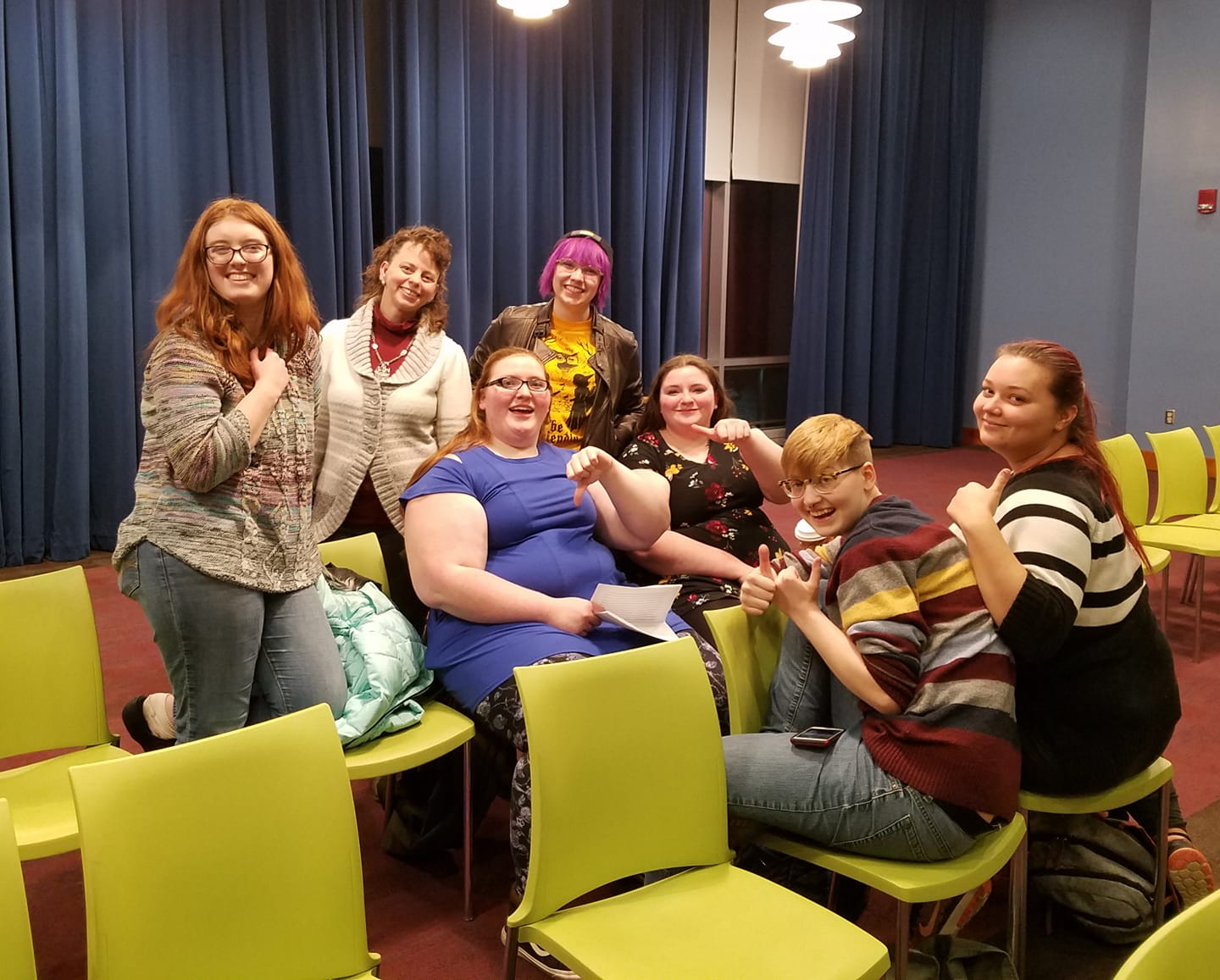
I am Johnathan Murray, the Director of the One Stop Center here at Finger Lakes Community College.  Like you, I am curious about Honors Studies, and it was this curiosity that prompted me to attend the College’s third Honors Studies Convocation.  The convocation took place on Wednesday, December 5th, and involved five Honors Scholars sharing their experiences with us.  It was an impressive, and moving event.  Each scholar shared an assignment from their course, and with their own unique style and voice, provided us with a window into the honors experience at FLCC.

Lisa Scott was up first, discussing HON 200 – Food and Identity in American Culture.  Lisa shared her experience growing up on a farm, and how it shaped her love of animals, and embrace of vegetarianism.  She showcased a genuine interest and passion for natural foods.

Mela Folan was next, discussing ENG 101 – Composition 1 Honors.  Mela provided an overview of the assignments she worked on in the course, and shared her initial apprehension about taking the course.  She, with the encouragement of her professor, discussed the detailed essay she wrote about smoothies.

Next, was the sister duo of Persy and Luc Woodruff.  Trista introduced the pair as de-facto twins, and noted their proclivity for collaboration.  The sisters shared their experience in HON 200 – Games and Storytelling.  The sisters took turns sharing the Vignettes they created in the course, about their names.  They each told a moving story.

Last, but not least, was Mara Cornwall.  Mara presented on ENG 230 – Perspectives on Tolkien, a course that is on my personal bucket list.  In Mara’s course they watched the classic animated Hobbit film from the 70s.  Visions of a green frog-esque Gollum jumped around in my head, as Mara related a quote from the film to her own experience as an honors scholar.

The Honors Studies Convocation was a wonderful event.  It highlighted the wonderful work of our honors students. 

I hope to see you at the next convocation.  Remember, ‘all you have to be is curious’!

-Johnathan


Thursday, May 24, 2018

My Honors Journey - Student Words

Vol 2 No 28

Below is the transcript of the speech given by graduating Honors Studies Scholar Tyler Deskins, class of 2018.  A graduate of the Liberal Arts and Sciences Mathematics track, Tyler is heading on to SUNY Potsdam in the fall to study math with the hopes of getting into their BA/MA concurrent program in the spring.  We wish Tyler all the best as he moves on.  Also, student guest bloggers are  my favorite posts to make and I hope that you enjoy it as well...


My name is Tyler Deskins and I am a mathematics major here at FLCC. (I hope that doesn’t scare anyone away) Today I’ve been asked to reflect a little on what the honors program has meant to me in my journey at FLCC.  I honestly don’t think it’s an exaggeration to say that without my involvement in this honors program, I would not be the type of learner that I am today.  At the very least, I would not be striving for academics in the way I am right now, nor would I have that drive that keeps me going.  A great deal of my development as a learner has occurred in these honors classes.  I’ve experienced some of my greatest challenges in them, I’ve celebrated some of my greatest triumphs in them with my fellow students, and perhaps most importantly, my college career started in the honors program as well.
My first semester attending FLCC was in the spring of 2015.  I was 16 years old at the time and this was meant to be an introductory semester for me.  Since the fourth grade up until that point in my life, I was homeschooled, and I had been away from a classroom for such a long period that I was just trying to get myself acclimated to the academic environment again.  I started by taking two classes that semester.  Loving mathematics, it was natural for me to take an introductory statistics class.  Not so natural, however, was my decision to enroll in an honors English 101 course.  At the time (I apologize Dr. Merrill) I detested English. * Dr. Merrill interjects “We’ve been doing this back and forth forever.” *  In part because I didn’t really know what the subject was.  I thought that English was learning information just to regurgitate it back to the professors.  Merely paraphrasing information, not the critical thinking I now know it to be.  Additionally, at the time I was quite nervous about my competency.  Without a high school education, I believed I would not be able to excel at the English course.  However, despite my anxiety over the subject (and with a bit of prodding from my parents), I enrolled.
The peak of my anxiety in that class occurred during our third class meeting.  I don’t recall why the subject was introduced, but we were having a class discussion about what we’ve learned in high school about English.  Part way though, Professor Margaret Gillio began her side of the discussion by saying “So we all know these ‘rules of English’ that we learned in high school…” and she began listing things such as paragraph structure, how to format a sentence properly, etc.  My heart sank.  Never had I formally learnd those rules.  I could understand them – after all, I had passed the placement exam to get into English 101 – but I was terrified that I would now be failing this class because I did not have these rules memorized.  And then I heard her say (I’m paraphrasing a little, but not much) “Now you know that list of rules you learned in high school?  Take it, crumple it up, throw it out the window.  It does not belong in a collegiate level English classroom. Part of what you will be doing in this class, and what may be a great challenge for some of you, is unlearning these supposed ‘rules.’”  That little speech gave me a great deal of encouragement because, for what seemed like the first time, I realized I was ahead of the curb because I didn’t have a high school education; which was awesome!!  As a result, I attacked the rest of the work in that semester.  Instead of just trying to pass the class I actively engaged with the material and gave it thought.  It was still very challenging for me, but I enjoyed every minute of it.  It was such an amazing learning experience for me. 
            My next semester – again, I was attending part time so I only took two classes that semester as well – I didn’t enroll in any honors classes.  In part because I didn’t know what the difference between honors and non-honors classes were.  The two classes I took were Interpersonal Communications and another English class; Composition II.  Surprisingly, that Composition II class is probably one of my favorite classes I’ve ever taken, largely because the instructor ran it much like an honors class.  The Interpersonal Communications class felt very… different; and not in a good way.  I disliked the class’s lecture style as well as the expectation of just assimilating information – like what I thought English was the year before – just to regurgitate it on an exam or paper.  I didn’t at the time, but I now understand what sets the Honors Classes apart.  In an Honors Class, the goal is to foster and develop critical thought.  They use the course curriculum as an opportunity to practice critical thinking in a supportive environment.  In traditional classes, you get the most out of them if you have that ability to think critically but a lot can be missed without it.  In them, critical thought is a prerequisite for true understanding but not a learning outcome.
            The following semester I relapsed and found myself taking three honors classes; a Psychology class, an Introduction to Literature class, and a chemistry class (while not typically an Honors Class it was made one through an honors contract).  The first two subjects I never expected to engage in, much less enjoy.  But to my surprise I loved both of them and became really immersed in the material.  The chemistry class was much more challenging.  What an honors contract means is that I am essentially the only one in my class doing the critical thought that is the hallmark of an Honors Class.  It was very difficult without the community of Honors Students to help support my inquiry and development.  But I found this to be a very helpful learning experience as well.  This Semester I did an independent study– not an honors independent study but one in advanced mathematics – and the chemistry course from that semester helped prepare me for the inquiry that I would have to do on my own in order to understand the material.  This was my first step in doing such major inquiry on my own; something that I will certainly need to do again if I choose to pursue a graduate degree down the line.
            The following semester I took two of the hardest class I’ve ever taken; both Honors Classes.  One was Dr. Merrill’s perspectives on J. R. R. Tolkien – the author of the Lord of the Rings trilogy – and the other was a Philosophy of Ethics class by Dr. Worrell.  While I already enjoyed both subjects, these two classes forced me to engage with the material far deeper than I ever intended to.  To merely create work considered passable for both, I needed to sink a great deal of effort into each thought I put on paper.  They pushed the limits of my writing ability; they shattered the preconceived notion that I would never have to nor be able to write at such a level.  I struggled in each assignment but never gave up.  They make the education ahead of me look easy, and I am grateful for that.
            Unfortunately, that was my last semester taking an Honors Class.  For the past three semesters I’ve desperately tried to work some into my schedule but have had no success.  Regardless, I am thankful for just how well my Honors Classes have prepared me for traditional classes as I now have a firm grasp on the critical thought that is required to get the most I can out of them.  For instance, History was another subject I absolutely dreaded at the age of 16.  Similar to English, I thought it was simply repeating back to your professor the material that both you and they already knew.  I now know that assumption was completely false.  The two History classes I took at this college were amazing because I could look at them through a critical lens.  I could interact with the people in these classes who were also looking to critically engage with the material.  We tried to learn as much as we could about the causes and influences of major events and we didn’t just do that by passively listening to lectures.  We asked the professors, we challenged each other’s ideas, we found information on our own, and we had a blast doing it.
            Perhaps the most important thing my Honors Classes have taught me is to look at the interdisciplinary nature of subjects; that no subject exists in isolation.  This is especially true, believe it or not, for different topics in mathematics.  Mathematical topics are typically taught segregated.  Calculus I-III and Differential Equations are treated separate from Linear and Abstract Algebra, which in turn are treated separate from Geometry and Topology, etc.  If you’re just trying to take these classes and assimilate as much information as you can, you are certain to miss the big picture.  But when you start looking for and seeing all the connections between topics, in my opinion, that’s where the true beauty of mathematics can be found.  I mean, for goodness sake, I did a mathematics presentation this semester on forms of non-standard mathematical logic and their connections to Buddhist philosophy!  Treating the subjects as separate entities, such a natural connection may never have been made.  And this certainly isn’t a property exclusive to mathematics.
This constant curiosity is how I have developed myself as a learner and how I will continue to develop myself as a learner as I move on from FLCC.  Without this foundation that my Honors Classes have provided me with, I would not be the learner I am today.  Looking at my journey up ahead, it is very important to me that I have such a foundation.  For all the Honors instructors and students I’ve met in and out of Honors Classes –and for all people who have supported me throughout my journey as a student – I really want to thank you for creating such an amazing environment.  One where people who truly want to learn, to engage more with the material and dig deeper, can find this community and help each other grow in meaningful ways.  I hope that one day all of us accepting our honors diplomas will make you proud to have been the people who helped make us who we are.  Thank you.


Sunday, April 15, 2018

Seminars Matter

Vol 2 No 25

Lots of folks have begun to look at their classes for next semester and we are really excited about the Honors offerings. You heard a bit more about them at the Honors Studies dinner and can read the course descriptions on WebAdvisor, but that doesn't necessarily explain why you might want to take a seminar - or even what a seminar is or looks like.

So, why would you take a class that doesn't "do" anything other than fill a general elective? Part of that has to do with the other question. What IS a seminar?

Google's proprietary dictionary defines seminar as "a class at a college or university in which a topic is discussed by a teacher and a small group of students." Well, is that what a lot of classes at a college are? Perhaps just in between needed lectures, but still...that seems the heart of what college classes in general should be. The Online Etymology Dictionary has this to say:

"1887, "special group-study class for advanced students," from German Seminar "group of students working with a professor," from Latin seminarium "breeding ground, plant nursery" (see seminary). Sense of "meeting for discussion of a subject" first recorded 1944.

'Plant nursery' is a fascinating idea, but I'm not sure Honors Studies students are necessarily inclined to appreciate being compared to budding plants. But, it's getting a bit closer to the concept I'm aiming for when I think about what we mean by seminar. The first word there that stands out is 'special'. This is not to say that other classes for other students aren't special, but I firmly believe (and I admit I have a bias) that the special nature of Honors Studies seminars is more common than not. Far from being contradictory, this is really what I have observed and heard about the seminar experience. I often joke that if someone stuck their head into one of my Honors classes, they wouldn't necessarily be able to pick out the instructor compared to the students. That's more than just a joke - it's true. In the seminars more than in any other type of class, I'm sitting WITH students. There is now nothing in between them and I. We sit together as learners.

Now, I know that I can never fully erase my role as instructor with a suitcase full of grading and other responsibilities.  And I humbly lay claim to a little more expertise in general, given the number of years I've been in academia and studying whatever topic I've chosen, but to the extent that it is possible, I can learn from my students even as they learn from me.

Many of those who teach seminars do so because they want to research and dig more deeply into a topic about which they have an interest.  The thing about Honors Studies faculty (and many faculty in general) is that they have dedicated their lives to learning.  This is one of the ways they do so.  And this coming fall?  We have two amazing seminars coming that are the products of the passion, curiosity, and the enthusiasm of the instructors who are teaching them.

So, no...seminars might not fulfill a requirement in your degree (other than a general elective or a liberal arts elective), and perhaps there's nothing in them the connects to your program of study at all...but think larger than that.  There are few classes in any college anywhere where you will find a room full of people who truly chose to be there.  No one needs it, which means everyone wants it.  They don't necessarily come because they need the credit or the class or anything about it.  They come because they love the content of the course itself.  And that, my friends, is the best learning environment you will ever find.

This fall?

HON 200-90 : Games and Storytelling taught by Honors Studies Librarian, April Broughton.
HON 200-91 : Eat Me:  Food and Identity in American Culture, taught by Lori Vail of the Humanities department.

Come.  Learn.  Celebrate your own curiosity.  And, dare I say my little plants, grow.


Friday, October 6, 2017

Honors VIPs

Vol 2 No 5


The people who come to the Honors Studies Dinner are important people.

For one, the president of the college, Dr. Robert K. Nye, comes to share his insights and thoughts about Honors to all in attendance.  In the past, the Provost / Vice President of Academic and Student Affairs has come and done the same.  The Associate Vice President of Instruction says a few words.  At the tables can be seen the Associate Vice President of Academic Affairs and the Director of Student Life.  Esteemed faculty speak about their classes and the Director of Honors Studies shares a few words as well.

But, those aren’t the important people I’m talking about.

The important people are the students.  Honors Studies students and their curious friends come – and that’s who keeps all those folks up there ‘at the office’ after they’ve already put in a full day of work.  That’s why we write our remarks and our speeches, why we order T-shirts and other goodies, why we buy food and clear our calendars.  That’s why we are here for that evening – and for so many other hours throughout the summer and the academic year, as well.

Last Spring, I decided that I would not have an agenda for the dinner beyond those folks with titles saying a few things.  I would hand the microphone off to students in attendance and let them lead the charge of the evening because it was THEIR evening.  It was THEIR voices that we wanted to hear.  I wasn’t sure how it would go.  Sometimes, our Honors Studies students can be a bit shy or anxious about speaking up in a large group of people they don’t know.  But, like they have so many times before, they surprised me.

You’d think I’d get used to that and not be surprised anymore. Time and time again, students at this college in general and those involved in, and interested in, Honors in particular have surprised me with their passion and their curiosity.  Honors Studies has the power to change lives and people wanted to talk about it.  They wanted to tell others what they experienced and what they learned.  They wanted to talk about what Honors has done for them and why they were pursuing it.  They wanted to talk about what their classmates in Honors were doing and had done for them.  They wanted to talk about the teachers they’d met and the work they were doing.  They wanted others to know about this ‘secret gem’ at FLCC.**

That evening we gave them the chance to talk about something they’ve found here that is unlike what they expected to find, but more than they ever hoped it would be.  Whether they sought it or stumbled into it, believed in it or were mistaken about it, the students who spoke last semester – and Honors Studies students in general – love Honors.  And those who have titles and work at the college to bring the dinner and all the other Honors Studies events and opportunities to life also love it.  As our marketing voice recently said to me, “I always have time for Honors” and that really has nothing to do with me as Director.  It has everything to do with what Honors represents, what it offers, what it allows students to do and discover about themselves.  Honors has always meant this at FLCC and its exciting to find ways to help tell others about it and, in turn, help them achieve it.

So…won’t you join us?

** As it turned out, they also wanted fidget cubes, but that isn’t important right now.  :D

Friday, May 12, 2017

More Student Words

Vol 1. No 21

The following comes from David Drake, who is graduating this semester with 18 credits of Honors and transferring on to SUNY Oswego to major in Creative Writing and Linguistics.

"When I saw that the Honors Studies program would be full of active classes centered around seminar discussions rather than around lectures, I was thrilled! I knew I would benefit from this learning environment--students taking charge of discussions, instructors participating in homework assignments with the students, the atmosphere of autonomous learning (especially when given the option to pursue my curiosity with an Honors contract for a non-Honors course)--it was, in a word, perfect! Classrooms were full of mutual respect, even during times of challenges. Students collectively overcame obstacles together, and because of that, the students learned from each other just as much--and sometimes more--from the professor. And I think it was the same way with the professors: Their learning experiences continued by facilitating these Honor Studies courses. I am, simply and sincerely, honored to have been a part of the Finger Lakes Community College Honors Studies program!"

We wish Dave, and all the Honors Graduates, the very best as they head onward in their journey.


Monday, May 1, 2017

Honors Voices

Vol 1 No 20

Something of a long one this time....

The other day. in the face of a beautiful spring day, I thought my HON 200 - Analyzing Alice class might need a moment to gather their thoughts and focus on the class at hand before I turned class over to Linda Ross.  She was going to spend that class time talking about attachment (and attachment disorders) from a psychological standpoint and how it might relate to Lewis Carroll or even Alice herself.  So, I asked them to take out a sheet of paper and write for five minutes on this question I posed to them:  

What does Honors mean to you?

These are the responses I got...

"I preach to everyone how much I enjoy honors studies.  To me, it means seminars, a connection with your classmates and professor, and a jillion different interpretations of a common theme.  I feel like there's this amazing fellowship and mellowship that comes out these types of classes.  The students that are in these classes are dedicated to learning about the topic at hand and are typically very talkative and at times, argumentative.  Honors classes make learning fun an worthwhile.  It's not a chore to attend class, it's something to look forward to.  The professors play devil's advocate and warp your way of thinking to meanings originally thought unimaginable"

"Honors means curiosity.  It means wanting to take something, such as a topic, and wanting to learn more.  It's about exploring a new realm of learning that one may have never thought of exploring.  Honors is about taking something and diving into it deeper than ever before.  It's not about more work and being smart.  It's simply about being curious."

"Honors to me means being able to explore what interests me and the things I find interesting.  As a book lover and writer, Honors gives me the opportunity to read a lot and write a lot (!), which other classes don't allow or want.  Be being in this Honors class, I have realized how much I adore analyzing stories and writing about what the stories mean to me.  Honors therefore has helped me realize and understand more of myself, by being able to dig into, explore, and discuss what I like and what to learn more about.  Overall, Honors means being able to be me, and learn what I want to learn, by offering cool classes, which allow me to explore who I am."

"Honors here at FLCC means a more student-lead learning environment as opposed to a traditional lecture style college course.  This means lots of group discussions and participation as we are learning together not being taught at.  It also means reflecting on your learning experience.  By reflecting on your journey as a learning, you are better able to grow your ability to learn.  You will find what works for you and what you can improve upon.  Honors is also a better opportunity to connect with your teacher.  For me, my teachers are mentors not just lecturers.  Most important, Honors is a group of people excited to learn, just like you, not just people force to take a class."

"Honors was something initially that just mean another good way to get accepted in a four year college.  While this is true, it now means so much more.  Honors became something that I could be involved in outside of tedious, constant needed work.  It was Perspectives on Tolkien that I first took and now I am someone a bit different.  I was able to read and discuss something that I truly have an interest in, unlike most classes in high school.  I also was able to make friends in that Tolkien class that I have now outside the class, another aspect I didn't have my first year at college.  The community sense that I get in this 'elite' group of Honors students is of devotion, respect, and a feeling of ultimately being wanted."

"Honors means to me that it helps you to look deeper into a meaning that you would normally just brush upon somewhere else.  It's a chance to find something new in yourself.  English 101 Honors has us analyzing ourselves as a writer while Alice analyzes ourselves as a learner and how to understand deeper meaning.  Honors is a chance to step our of our boundaries and try something new."

"To me Honors reflects a community pursuit in an accountability-minded atmosphere.  We have a capability to discuss as opposed to being lectured and to grow in relationship to others in a more conducive atmosphere than a typical class.  In another sense it has an active palpability to discern via worldview and disciplinary confines."

"Honors means a different way to view subjects that 'regular' classes may not have the time / desire to do otherwise.  It's a place where I feel my opinions not only matter but are validated.  I don't feel excluded because I don't have the knowledge for a certain subject but rather it's a place where I can learn freely without fear of judgments"

"Honors is a means to challenge myself while having fun.  Most classes involving something that I actually like are Honors classes"

"What Honors means to me is a more challenging / higher level class that requires extra work and effort.  Also, I think of it as a more specialized / focused course rather than a introduction course.  It also presents some more interesting classes than what is normally offered in my opinion.  I also feel that the courses are better since they seem to be more focused and in smaller classrooms"

"Honors means a more interactive way of learning that provides the opportunity for classroom discussion and practical applications with a more discussion and writing-based curriculum that helps students to more easily express their thoughts and ideas.  The more hands-on approach also provides a sense of accomplishment for finished projects"

Monday, December 5, 2016

Found Honors

Vol. 1 No. 12
Recently, the Honors Advisory Board developed and conducted a survey of all students enrolled in an Honors course in the Fall 2016 semester.  I don’t know a lot about data and the like, but they tell me that the 26 responses we got back was an excellent return.  I hope to get even more next time we conduct one.  Those that did respond said some amazing things about Honors, though, and I would like to let you see what they said.  To that end, I’ve created a ‘found poem’ – where I built a poem using only the words that were provided on the survey.  The only changes I made were some spelling and tenses here and there.  Other than that, I simply rearranged phrases, shortened sentences, and removed some punctuation to come up with what you see below.  I hope you enjoy.

Honors Survey, 2016

I. The dedicated faculty...

My teachers have been wonderful
truly engaged with both the students and material
They set a great example for their students
and do much to encourage and sustain inquisitiveness
Relatable…
I like how they care about how we do and don't want us to do badly
they are genuinely invested in our education
Knowledgeable but humble and approachable
Teacher's teaching ability…hard work and preparation.
Caring…
The willingness of honors teachers
to go on a 25 minute tangent from the original discussion
to answer a legitimate question you had
about how the subject relates to something else
Eagerness…
Each faculty member is unique and has an interesting perspective
I find these individuals incredibly intelligent
and I want to learn as much as I possibly can from them.
                their dedication to ensure an actual learning experience occurs.
                                                                                    Realness…
Always…seem to care very deeply about what they’re teaching
this makes it much easier as a student to feel engaged
how dedicated they are to their work.
professionalism mixed with fun discussions
Understanding…
The teacher is mostly hands off…

II. The classroom scenery

The relaxed atmosphere is so comforting especially during stressful times
It allows us to learn the way I think we should;
Allowing for students to guide class discussion
Everyone in the class has the same or more interest in the topic as I do

The connection you build with your classmates
because of the small groups you're taught in
                When students teach each other they learn more
and are more interested and motivated to study as well

The small classes, comforting atmosphere,
class discussion rather than lecture, interesting topics
Honors classes attract individuals interested in learning
and having fun while doing so…the atmosphere

III. The honors experience…

It has been one of the best experiences of my life
It's unlike any class I’ve ever had
Honors have been an amazing experience
It helped me to see things differently
Honors just needs to be experienced to be fully understood


Tuesday, November 15, 2016

Go Ask Alice...

Vol 1. No 10.

The following is a slightly edited version of the remarks I made at the Honors graduation ceremony last May.  Since Alice is being offered in the Spring and we are all of us gearing up to end another semester, it seemed fitting to revisit these words of celebration.  The edits made were to tidy up some of the language that didn't quite convey what I should have conveyed...

***

Curiouser and curiouser!’ cried Alice (she was so much surprised, that for the moment she quite forgot how to speak good English); `now I’m opening out like the largest telescope that ever was! Good-bye, feet!’ (for when she looked down at her feet, they seemed to be almost out of sight, they were getting so far off).
….
Alice took up the fan and gloves, and, as the hall was very hot, she kept fanning herself all the time she went on talking: `Dear, dear! How queer everything is to-day! And yesterday things went on just as usual. I wonder if I’ve been changed in the night? Let me think: was I the same when I got up this morning? I almost think I can remember feeling a little different. But if I’m not the same, the next question is, Who in the world am I? Ah, THAT’S the great puzzle!

Since I began in the position of director, I’ve spent a good deal of time thinking on this very question in regards to Honors.  I’ve led and attended workshops and conferences, written descriptions of the Honors experience, collaborated with fellow devotees on a mission and goals and I’ve had conversations – so many conversations – with family, friends, students, alumni, faculty, and staff about this very thing.  I had been teaching Honors on and off for years and so I felt that I knew it well, but when charged with the task of leading it and growing it, I came to realize that articulating and codifying the Honors identity was no small feat.

No need to despair, however, for two things quickly came to the forefront of numerous conversations in numerous arenas as being hallmarks of what we do here:  curiosity and transformation.  All of us involved with Honors know that these things apply to the students who were drawn into and become engaged in the Honors experience.  You are those students; you’ve felt the eagerness of learning, the power of being curious, the joy and confidence that can come from a shared intellectual endeavor with like-minded classmates.  You have grown and been changed by your experiences here, and they will stay with you in some measure as you continue here or move onward.  You embody what it means to be Honors and Honors could not exist without you.

For others of you, you serve a different role:  you know those students, you’ve supported them as they struggled and triumphed, smiling at their enthusiasm and doing your best to help them channel their energy.  You have watched with pride and sometimes confusion as your personal Alice changed before your eyes – sometimes more rapidly than you could have expected.  You are an important part of what enables us to be here tonight, encouraging and recognizing the students we are honoring because they got here with your support.  Honors could not exist without its vast network of friends and family standing on the sidelines cheering on our scholars.

But there is still someone else for whom these words ring true.  The Honors faculty.

We are proud of our shiny new slogan that informs and invites students into Honors by telling them that all they need to be is curious, and at first I was somewhat surprised to find myself using this slogan among the faculty.  The more I thought about it, however, the more I realized that what happens in Honors courses is not just transformative for the students, but it is often equally so for the faculty who elect to teach them.  Honors courses also serve as an invitation for us to explore topics of interest, to satiate our quest for knowledge and learning that may be off the beaten path but still within our fields.  It is an invitation to look at our core courses in different ways and explore the boundaries with which we are so familiar.  Just like Alice experiences with her change in size, Honors courses can surprise us into looking at ourselves and our disciplines in whole new ways.  I am not the same professor that I was years ago – and while I’m sure that is true for most instructors who stay in the teaching profession, I can make a direct correlation between my transition and my experiences in Honors.  I have gone from being simply Dr. Merrill to being Teach and I am proud of that shift.  My students remind me what it’s like to be excited about learning and they expand my horizons every time I work with them.  I am curious, and they are curious right along with me.  I am passionate and enthusiastic and they have that same passion and enthusiasm.  We feed off each other and the classroom environment – no, the whole learning experience -- is better for all of us.  I know that I would not be the teacher I am without Honors and I know that my fellow faculty feel the same.  So, thank you – thank you for being a constant reminder of why we are here and for making us better than we were.

We are all of us Alice and I am proud to be among you.