

Friday, December 21, 2018

Monday, December 10, 2018
Fall 2018 Convocation - Guest Blogger
Vol 3 No 13
 This
edition of Honors Matters is brought to us by a guest – not just a guest
blogger, but also a guest at the Fall 2018 Honors Studies Convocation. It is tradition to have the ‘report’ of the
event come from someone other than myself.
This way, you get to hear the voice of another who is invested in, and intrigued
by, Honors. I would like to thank those
who attended and also those who presented.
You will read more about those presentations below. I would also like to thank those who made
posters for this semester’s Convocation:
Brianna Smith and Bucket Abdallah (Perspectives on Tolkien), Rebeccas
Rayne (Math for Liberal Arts Majors), and Persy Woodruff (Games and
Storytelling). Now, without further ado,
let us read about the presentations!
This
edition of Honors Matters is brought to us by a guest – not just a guest
blogger, but also a guest at the Fall 2018 Honors Studies Convocation. It is tradition to have the ‘report’ of the
event come from someone other than myself.
This way, you get to hear the voice of another who is invested in, and intrigued
by, Honors. I would like to thank those
who attended and also those who presented.
You will read more about those presentations below. I would also like to thank those who made
posters for this semester’s Convocation:
Brianna Smith and Bucket Abdallah (Perspectives on Tolkien), Rebeccas
Rayne (Math for Liberal Arts Majors), and Persy Woodruff (Games and
Storytelling). Now, without further ado,
let us read about the presentations!
Greetings blogosphere,
 I am Johnathan Murray, the Director of the One Stop Center here
at Finger Lakes Community College. Like you, I am curious about Honors
Studies, and it was this curiosity that prompted me to attend the College’s
third Honors Studies Convocation. The convocation took place on
Wednesday, December 5th, and
involved five Honors Scholars sharing their experiences with us. It was
an impressive, and moving event. Each scholar shared an assignment from
their course, and with their own unique style and voice, provided us with a
window into the honors experience at FLCC.
I am Johnathan Murray, the Director of the One Stop Center here
at Finger Lakes Community College. Like you, I am curious about Honors
Studies, and it was this curiosity that prompted me to attend the College’s
third Honors Studies Convocation. The convocation took place on
Wednesday, December 5th, and
involved five Honors Scholars sharing their experiences with us. It was
an impressive, and moving event. Each scholar shared an assignment from
their course, and with their own unique style and voice, provided us with a
window into the honors experience at FLCC.
Lisa Scott was up first, discussing HON 200 – Food and Identity
in American Culture. Lisa shared her experience growing up on a farm, and
how it shaped her love of animals, and embrace of vegetarianism. She
showcased a genuine interest and passion for natural foods.
 Mela Folan was next, discussing ENG 101 – Composition 1
Honors. Mela provided an overview of the assignments she worked on in the
course, and shared her initial apprehension about taking the course. She,
with the encouragement of her professor, discussed the detailed essay she wrote
about smoothies.
Mela Folan was next, discussing ENG 101 – Composition 1
Honors. Mela provided an overview of the assignments she worked on in the
course, and shared her initial apprehension about taking the course. She,
with the encouragement of her professor, discussed the detailed essay she wrote
about smoothies. Next, was the sister duo of Persy and Luc Woodruff. Trista
introduced the pair as de-facto twins, and noted their proclivity for collaboration.
The sisters shared their experience in HON 200 – Games and Storytelling.
The sisters took turns sharing the Vignettes they created in the course, about
their names. They each told a moving story.
Next, was the sister duo of Persy and Luc Woodruff. Trista
introduced the pair as de-facto twins, and noted their proclivity for collaboration.
The sisters shared their experience in HON 200 – Games and Storytelling.
The sisters took turns sharing the Vignettes they created in the course, about
their names. They each told a moving story. Last, but not least, was Mara Cornwall. Mara presented on
ENG 230 – Perspectives on Tolkien, a course that is on my personal bucket
list. In Mara’s course they watched the classic animated Hobbit film from
the 70s. Visions of a green frog-esque Gollum jumped around in my head,
as Mara related a quote from the film to her own experience as an honors
scholar.
Last, but not least, was Mara Cornwall. Mara presented on
ENG 230 – Perspectives on Tolkien, a course that is on my personal bucket
list. In Mara’s course they watched the classic animated Hobbit film from
the 70s. Visions of a green frog-esque Gollum jumped around in my head,
as Mara related a quote from the film to her own experience as an honors
scholar.
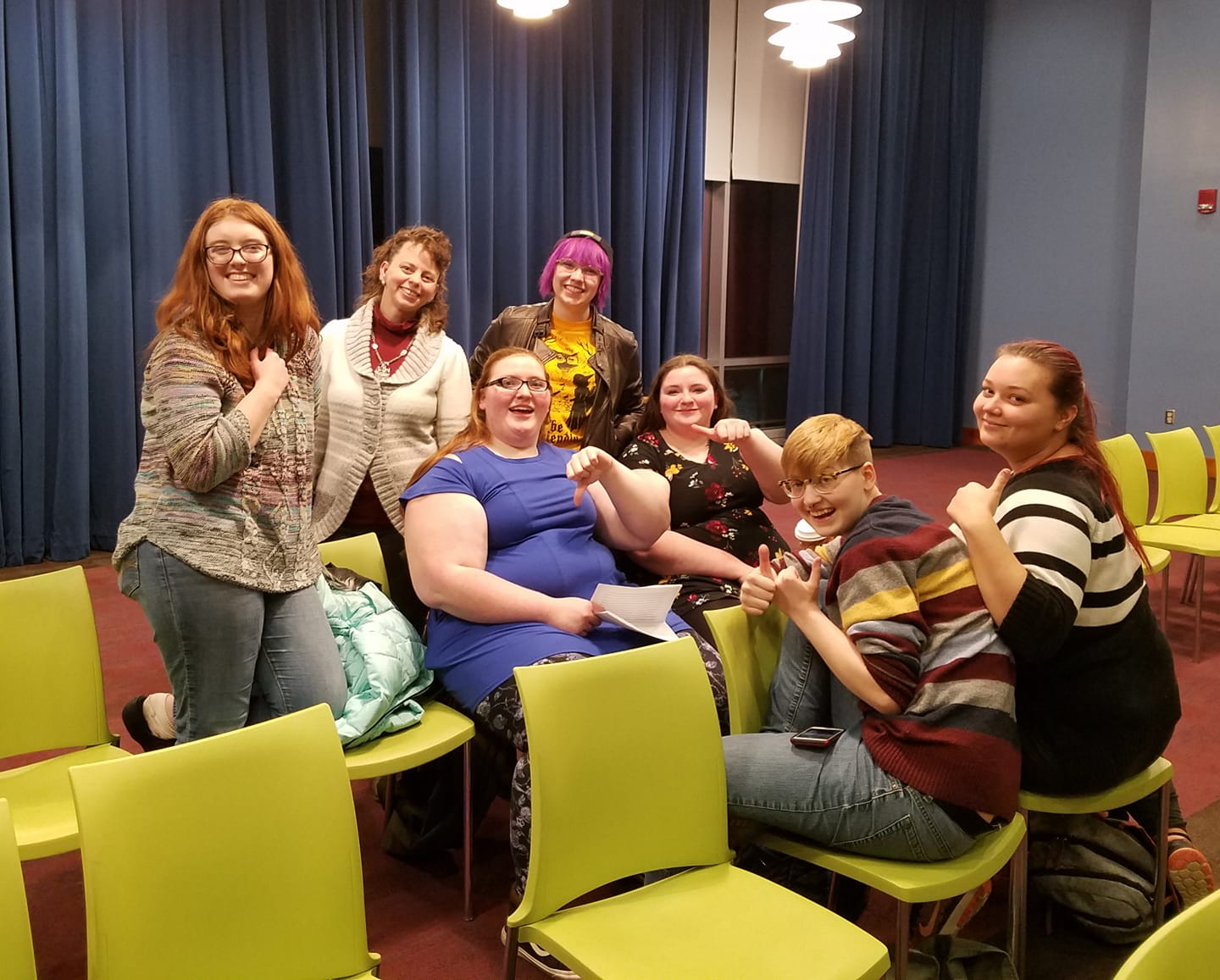
The Honors Studies Convocation was a wonderful event. It
highlighted the wonderful work of our honors students.
I hope to see you at the next convocation. Remember, ‘all
you have to be is curious’!
-Johnathan
Monday, December 3, 2018
Here is a Stick
Vol 3 No 12
Hello, friends.
 Seasonal Affective Disorder.
Mental health issues in general.
Finals. The Holidays. Any number of things can cause us to long to
run away and hide. We all face
challenges of varying levels of difficulty as we go from day to day. It can make even the smallest task seem
daunting. It can become harder to eat,
sleep, socialize, be productive. And now
that we are in the last few weeks of classes, I am sure that this sounds like a
familiar song to some of you.
Seasonal Affective Disorder.
Mental health issues in general.
Finals. The Holidays. Any number of things can cause us to long to
run away and hide. We all face
challenges of varying levels of difficulty as we go from day to day. It can make even the smallest task seem
daunting. It can become harder to eat,
sleep, socialize, be productive. And now
that we are in the last few weeks of classes, I am sure that this sounds like a
familiar song to some of you.
The title of this blog comes from an owl named Boggle. In the post, Boggle explains a few things about asking for help and about the things we can do for one another. And for ourselves.
I want to tell you that you are going to be okay. In order for that to be true, though, I need
you to do something for me. Or rather, for you.
What I need you to do is get a 3 x 5 card or something similar
and write the following words on it:
I AM WORTH IT
Then, on the back of the card, write down that you are worth
the following things:
·
Self-care
·
A good night’s sleep
·
Fun and adventure
·
A good meal
·
The help of a friend
·
The help of a professional
I suspect you are starting to see where I am going with this. Only one of those things is bolded and that’s
because all of the other ones fall under that one main one. I encounter students everyday who are not
engaging in that first bullet in one way or another and I want so badly to be
able to help them. One thing I can do is
to tell you that you are worth taking
the time for self-care. I think too
often we feel that we have to push ourselves to distraction without stopping to
breathe and relax. But this relaxation
is so important. We have to stop and
focus on ourselves now and then or all of those outside forces will keep
pulling on us. So, what is self-care?
“’Self-care’ refers to the active process of recovering,
maintaining and improving one’s health” (Ziguras). I love that this definition includes three
levels of health – which means that it applies to all of us, regardless of our
general mental health status. Engaging
in self-care means that you need to accept that you are worth caring
about. You are worth the care you give
yourself and the care that is offered to you by others.
And how do you engage
in self-care? Well, that depends a
little bit on who you are, because “[f]orms of self-care are as numerous and
diverse as the number of people who practice them; they run the gambit from
extreme workouts to binge-baking sessions” (Carlson). So engaging in self-care means that you need
to know a little bit about who you are. You
really need to know what brings you some small measure of happiness or
relaxation. It can be anything from
reading a book for a little while to practicing yoga, playing a video game to going
for a walk, doing 50 jumping jacks and painting your toenails to watching cat
videos for twenty minutes and drinking hot cocoa.
You notice something there?
Self-care does not have to involve that you wholly sacrifice your academic
or professional success. One of the most
liberating things we can accept is that self-care does not mean giving up on
your tasks or delaying your responsibilities to a dangerous level. Self-care does not have to take hours of your
time, nor does it have to cost a lot of money or require you to go anywhere in
particular. What it all boils down to is
taking the time to do something that will help you relax and refocus. Without these moments of indulgence, our
stress and mental health runs the risk of becoming too much for us to handle. We have to let some of the pressure off –
reward ourselves for hard work and persistence, for doing something difficult
or making progress on a project. Self-care “doesn’t need to be anything
elaborate” nor do we “need to do it all at once;” we just have to remember that
“trying to fit in the basics is a great place to start,” because that will “give
us a solid foundation to work from” (“Self-care”).
YOU ARE WORTH ALL OF THIS.
This said, I cannot stress enough that if you get to the
point where you feel you cannot handle the stresses in your life, you should
seek out someone you trust and get help.
Help-seeking is one of the most important and the hardest things we can
do that falls under the category of self-care.
There is no shame in asking for help and although it might be difficult,
it’s one of the most important things you can do. We have counseling services on campus, and there
are numerous faculty and staff who can help you find the services you
need. Don’t stay lost and alone if you
can’t handle the stressors in your life.
Help is out there for you. It is
a sad truth that “despite the relatively high prevalence of elevated stress and
mental health difficulties in college students, research has consistently
revealed that most students who have a problem do not seek help” (Hubbard, et
al).
Better for me is finding the best possible way to live and function while having struggles. I want to continue to grow and understand why my brain works the way it does. I want to learn how to prevent myself from closing off when I’m hurt. I want to put the work in and be able to stay rooted and confident in myself, my beliefs, and my mental state. I want to be the best me (Milner)

Works Cited
Carlson, Melissa.
“Finding Health and Happiness the Write Way: Blogging as Self-Care Within
Student Affairs and Higher Education.” Vermont
Connection, vol. 36, Jan. 2015, pp. 23–30. EBSCOhost,
ezproxy.flcc.edu/login?url=http://search.ebscohost.com/login.aspx?direct=true&db=eue&AN=101367094&site=eds-live.
Accessed 3 Dec. 2018.
Hubbard,
Kimberly, et al. “Stress, Mental Health Symptoms, and Help-Seeking in College
Students.” Psi Chi Journal of
Psychological Research, vol. 23, no. 4, Fall 2018, pp. 293–305. EBSCOhost,
ezproxy.flcc.edu/login?url=http://search.ebscohost.com/login.aspx?direct=true&db=a9h&AN=132602564&site=eds-live. Accessed 3 Dec. 2018.
Milner, Alex. "The Reality of 'Getting Better.'" To Write Love on Her Arms. 26 Nov. 2018, twloha.com/blog/the-reality-of-getting-better/. Accessed 3 Dec. 2018.
“Self-care for Busy
People.” Blurtitout.org. The Blurt
Foundation, 24 Oct. 2017, www.blurtitout.org/2017/10/24/self-care-for-busy-people/. Accessed 3 Dec. 2018.
Ziguras,
Christopher. Self-care: Embodiment, Personal
Autonomy and the Shaping of Health Consciousness. Routledge, 2004. Google
Books. books.google.com/books?id=CksXt89K-6QC&printsec=frontcover&source=gbs_ge_summary_r&cad=0#v=onepage&q&f=false. Accessed 3 Dec, 2018.
Wednesday, November 28, 2018
Feeling Creative?
Vol 3 No 11
The following comes to us from the Genesee Valley Council on the Arts, and, more specifically, a former FLCC student named Connor Keihl. He did an internship over the summer and when he saw this competition come through, he immediately thought of the experiences he had as a student at FLCC and times he had in the Honors House. I know it's a rough point in the semester, but you absolutely have time and you might just find that writing a story clears your head and relieves some stress. Best of luck to all who take this on!
GVCA’s
New Deal Writing Competition
The Genesee Valley Council on the
Arts is hosting their fourth annual New Deal Writing Competition! This is a short story competition
where the writer is asked to use a painting chosen by the staff of GVCA as
inspiration for their short story. For this year’s competition, we have
selected Jacques Zucker’s “Fountain, Central Park” from our New Deal art gallery
as your inspiration. The painting chosen is featured below.

GVCA will
be accepting submissions for the competition from July 1, 2018 - April 5, 2019.
The first-place winner will be awarded $200, second-place $100, and third-place
$50. However, the first-place winner will additionally be published in GVCA’s
annual magazine, Artsphere. This is
an international competition, so we hope to receive a wide array of
submissions, however it should be noted that prize money will be given in U.S.
dollars. This contest will use blind judging—that is, the author’s name will be
withheld from the judges until the competition is complete—so we ask that every
author omit their personal information from their piece(s). Instead, please
include a one-page cover sheet for each submission that includes: title,
author, address, and phone number.
Here are some more guidelines and requirements for the
competition:
●
There is a $5.00
submission fee per piece submitted, up to three (3) pieces
●
Entrants must be 18+
years of age
●
The piece submitted
must be previously unpublished
●
All entries must be
10,000 words or less
●
There are no genre
restrictions
●
Winners will be
announced May 5, 2019
●
Email entries to
betsy@gvartscouncil.org in WORD doc format
If you’re interested in reading the pieces of winners
from previous years, or finding out more information about the contest, check
out our website: http://gvartscouncil.org/writingcompetition/
Thank you for submitting!

Thursday, November 15, 2018
Posters, Parties, and Presentations
Vol 3 No 10
We are rapidly hurtling toward the end of the semester and it's not going to slow down until we get right to the end. It's always amazing to me that the end sneaks up on me every time. This is my 15th year of teaching and I'm STILL surprised that next week is Thanksgiving and and then we are on into December.
And speaking of December, there's an amazing opportunity for all Honors students and I hope I will encourage you to take part. It's the Fall 2018 Honors Convocation. Twice now we have hosted an Honors Convocation and both times it has been an amazing experience for those who participated. The first part is something open to all. The poster session.
 Poster sessions are a staple of student and faculty conferences and research across all disciplines and in all sorts of contexts. It's more than just a chance to be creative and colorful, it's also an opportunity to think about what is truly significant and important about the work you are doing. Showcasing this work celebrates the importance of intellectual rigor and taking the value of your learning beyond the walls of the classroom. Faculty at North Carolina State University describes this kind of poster as a "[a] source of information, [a] conversation starter, [an] advertisement of your work, [and a] summary of your work" (Hess, Tosney, Liegel). To be effective, a poster has to be a "visual communication" so that you can "get your main point(s) across to as many people as possible" (Hess, Tosney, Liegel). We aren't a formal conference and you won't be judged on your poster, which makes this the perfect place to practice a skill that will serve you well as you move on in your academic career. So, plan a poster!
 To help with the poster making process, we will be gathering at the Study-a-Thon in the library on 11/29 at 7:00 to make posters together. I'll bring markers, crayons, colored pencils, and poster board. Bring any supplies you need and come on out! There's food and other amazing things in the library that evening, as well. Come relax and make posters with us. I always end up wanting to go home after I've committed to going to this evening in the library, but you know what? It does me good. I always have an amazing time with the students who gather and we have great conversations about everything from what's going on in our Honors classes to popular television shows to plans for the future both near and far. At this point in the semester, it is so important to take time out to just relax and making a poster can be a great way to do that. You don't need to be an artist or creative or even prone to staying in the lines when you color. You just have to figure out how to visually represent something you're learning. We have to brag about Honors, so let's do it together. And let's do it in a way that lets us relax a little bit as well. You can even get help with other classes as well - or play games, have snacks, get a massage. So many worthy reasons to go.
As for the Convocation, there's another piece in addition to the poster display. That evening, for an hour, we gather in Stage 14. This is a very special capstone for the day. At that time, four Honors students will present their work to those in attendance. They will present some aspect of the work they've done and leave some time for questions as well. As something of a mini conference, these students are invited to practice skills that will serve them so well as they move forward in their academic and professional careers. Although speaking about a large conference on criminal justice, I agree with a faculty member who describes presenting as "the opportunity to showcase and get feedback on your work" as well as being "an opportunity to make connections, collaborate and explore" (Beshears) In short, it's a way "to feel as though you are making a real difference" (Beshears). In the last two Convocations, we have had everything from memoirs and literary narratives to research papers and reflective essays. Students have shared portions of their projects, journals, papers, presentations, or other elements of their work. Perhaps this will be YOU?
Beshears, Michael L. "The Benefits of Presenting and Attending Professional Conferences." In Public Saftey. American Military University, 13 Mar. 2017, inpublicsafety.com/2017/03/benefits-presenting-attending-professional-conferences/. Accessed Nov. 2018.
Harper, Douglas. "Convocation." Etymonline. Online Etymology Dictionary, 2018, www.etymonline.com/word/convocation#etymonline_v_18320. Accessed 15 Nov. 2018.
Hess, George, Katherine Tosney and Leon Liegel. "An Effective Poster." Creating Effective Poster Presentations. North Carolina State University, 2013, projects.ncsu.edu/project/posters/index.html. Accessed 15 Nov. 2015.
convocation (n.)
late 14c., convocacioun, "assembly of persons; the calling or holding of a meeting, assembling by summons," from Old French convocation and directly from Latin convocationem (nominative convocatio) "a convoking, calling, or assembling together," noun of action from past-participle stem of convocare "to call together," from assimilated form of com "with, together" (Harper)
We are rapidly hurtling toward the end of the semester and it's not going to slow down until we get right to the end. It's always amazing to me that the end sneaks up on me every time. This is my 15th year of teaching and I'm STILL surprised that next week is Thanksgiving and and then we are on into December.
And speaking of December, there's an amazing opportunity for all Honors students and I hope I will encourage you to take part. It's the Fall 2018 Honors Convocation. Twice now we have hosted an Honors Convocation and both times it has been an amazing experience for those who participated. The first part is something open to all. The poster session.

 To help with the poster making process, we will be gathering at the Study-a-Thon in the library on 11/29 at 7:00 to make posters together. I'll bring markers, crayons, colored pencils, and poster board. Bring any supplies you need and come on out! There's food and other amazing things in the library that evening, as well. Come relax and make posters with us. I always end up wanting to go home after I've committed to going to this evening in the library, but you know what? It does me good. I always have an amazing time with the students who gather and we have great conversations about everything from what's going on in our Honors classes to popular television shows to plans for the future both near and far. At this point in the semester, it is so important to take time out to just relax and making a poster can be a great way to do that. You don't need to be an artist or creative or even prone to staying in the lines when you color. You just have to figure out how to visually represent something you're learning. We have to brag about Honors, so let's do it together. And let's do it in a way that lets us relax a little bit as well. You can even get help with other classes as well - or play games, have snacks, get a massage. So many worthy reasons to go.
As for the Convocation, there's another piece in addition to the poster display. That evening, for an hour, we gather in Stage 14. This is a very special capstone for the day. At that time, four Honors students will present their work to those in attendance. They will present some aspect of the work they've done and leave some time for questions as well. As something of a mini conference, these students are invited to practice skills that will serve them so well as they move forward in their academic and professional careers. Although speaking about a large conference on criminal justice, I agree with a faculty member who describes presenting as "the opportunity to showcase and get feedback on your work" as well as being "an opportunity to make connections, collaborate and explore" (Beshears) In short, it's a way "to feel as though you are making a real difference" (Beshears). In the last two Convocations, we have had everything from memoirs and literary narratives to research papers and reflective essays. Students have shared portions of their projects, journals, papers, presentations, or other elements of their work. Perhaps this will be YOU?
Works Cited
(with implied hanging indents)
Harper, Douglas. "Convocation." Etymonline. Online Etymology Dictionary, 2018, www.etymonline.com/word/convocation#etymonline_v_18320. Accessed 15 Nov. 2018.
Hess, George, Katherine Tosney and Leon Liegel. "An Effective Poster." Creating Effective Poster Presentations. North Carolina State University, 2013, projects.ncsu.edu/project/posters/index.html. Accessed 15 Nov. 2015.
Monday, November 12, 2018
Join Us!
Vol 3 No 8
I spent last week at the National Collegiate Honors Council annual conference. This year, in Boston, we were treated to some excellent presentations and breakout session on every topic from assessment to outreach, from study abroad to preparing for interviews. The theme of the conference was "Learning to Transgress" and while there were many presentations and discussions on this topic (transgress: infringe or go beyond the bounds of (a moral principle or other established standard of behavior). That said, however, the most common thread I saw was how to better help and serve students facing various issues with mental health. It was nice to see it so openly talked about and I will talk more about it in another blog.
What I want to do in this blog is invite you to experience some new adventures with us.
First, classes for Spring 2019. While we don't have a LOT of options, the choices we do have are amazing and well worth making room for in your schedule if you can. You'll see posters going up soon - and here's a look at the main one:

See what I mean? Important topics in writing and literature. Vital issues that face women and minorities in today's world. And then the seminars - one on Harry Potter and the other on superheroes? How can you go wrong? Remember, anyone can sign up for Honors courses; so, grab your friends, make room in your schedule, and go for it!
The second invitation is for a new place for Honors students and those interested in Honors to gather and converse. Like Facebook Messenger, it allows for group conversations and individual messages, but it does NOT require Facebook. Called GroupMe, it allows you to create an account using Facebook, email, a phone number, or an already existing Microsoft account. Just click here to join us: FLCC Honors Studies Gathering Place.
 You can also scan this code with your phone camera and it should hook you up!
You'll be seeing this link on Facebook and Twitter and even via email and on posters in the near future. We hope you'll help us create something of an Honors House online!
I spent last week at the National Collegiate Honors Council annual conference. This year, in Boston, we were treated to some excellent presentations and breakout session on every topic from assessment to outreach, from study abroad to preparing for interviews. The theme of the conference was "Learning to Transgress" and while there were many presentations and discussions on this topic (transgress: infringe or go beyond the bounds of (a moral principle or other established standard of behavior). That said, however, the most common thread I saw was how to better help and serve students facing various issues with mental health. It was nice to see it so openly talked about and I will talk more about it in another blog.
What I want to do in this blog is invite you to experience some new adventures with us.
First, classes for Spring 2019. While we don't have a LOT of options, the choices we do have are amazing and well worth making room for in your schedule if you can. You'll see posters going up soon - and here's a look at the main one:

See what I mean? Important topics in writing and literature. Vital issues that face women and minorities in today's world. And then the seminars - one on Harry Potter and the other on superheroes? How can you go wrong? Remember, anyone can sign up for Honors courses; so, grab your friends, make room in your schedule, and go for it!
The second invitation is for a new place for Honors students and those interested in Honors to gather and converse. Like Facebook Messenger, it allows for group conversations and individual messages, but it does NOT require Facebook. Called GroupMe, it allows you to create an account using Facebook, email, a phone number, or an already existing Microsoft account. Just click here to join us: FLCC Honors Studies Gathering Place.
You'll be seeing this link on Facebook and Twitter and even via email and on posters in the near future. We hope you'll help us create something of an Honors House online!
Friday, November 2, 2018
We Got Hugs
Vol 3 No 8
The following is a transcript of the little speech I gave at the Honors Dinner on October 30, 2018. We had an amazing gathering of faculty, students, staff, and alumni where we shared food, stories, hugs, tears, and laughter. For those who came, thank you. For those who did not - I hope to see you at next semester's dinner. :)
 There is a Tweet that keeps popping
up on my Facebook feed that says “we have officially hit the point in the
semester where every college kid is at least half sick, probably in the midst
of an emotional breakdown, and very behind in several classes. Please be nice to us. We’re trying our best and we all just need a
hug.” This has resonated with me for a
number of reasons, not the least of which is that it is also true for faculty –
but that isn’t really important right now.
What gets me about it is that I first saw it right after I sent out the
Honors Study survey and, for those of you that did it, you’ll remember that
there was a question on there that asked what concerns you face as a
student. The top three responses are so
telling: Time management or
procrastination (73%), stress (71%), and (tied for third) work load and mental
health (49%). Ouch, right? It rather makes me wonder how different the
responses would be if I had asked at the beginning of the semester. Part of me thinks they would be radically
different, but part of me thinks that Honors students tend to be aware enough
to know that they face these things regardless of what point of the semester we
happen to be in.
There is a Tweet that keeps popping
up on my Facebook feed that says “we have officially hit the point in the
semester where every college kid is at least half sick, probably in the midst
of an emotional breakdown, and very behind in several classes. Please be nice to us. We’re trying our best and we all just need a
hug.” This has resonated with me for a
number of reasons, not the least of which is that it is also true for faculty –
but that isn’t really important right now.
What gets me about it is that I first saw it right after I sent out the
Honors Study survey and, for those of you that did it, you’ll remember that
there was a question on there that asked what concerns you face as a
student. The top three responses are so
telling: Time management or
procrastination (73%), stress (71%), and (tied for third) work load and mental
health (49%). Ouch, right? It rather makes me wonder how different the
responses would be if I had asked at the beginning of the semester. Part of me thinks they would be radically
different, but part of me thinks that Honors students tend to be aware enough
to know that they face these things regardless of what point of the semester we
happen to be in.
Lately, it feels like I do nothing
in my classes but teach content and talk about the crises we are facing in the
world around us – the barrage of dark and painful news that greets us each day
and makes many of our hearts hurt. But,
as much as we are members of communities both large and small, I think that it
is equally important to acknowledge that our individual worlds are in flux as
well. This is not a permanent state and,
in some cases, it’s just par for the course as we watch October die into
November and realize how few short weeks there are until the end of the semester
(seven, counting Thanksgiving, if you’re wondering). I mean, this is what you all signed up for as
students right? You are rapidly becoming
used to this, if you haven’t become so already.
I mean, it still hits you like a ton of bricks every time, but at least
it’s not catching you entirely off guard anymore.
…right.
 Anyway, this feeling becomes even
more pronounced for Honors students, and not because the courses are harder,
exactly, but because the demand on you is a little bit higher. Sometimes – okay, nearly all of the time –
this demand on you comes equal parts from yourself as well as your faculty. 37% of you wouldn’t value class discussions more
than other aspects of your Honors courses if you weren’t actually
participating. It’s hard to hide when
its seminar seating, and personal reflection requires a certain amount of
vulnerability. That teaching style that
over half of you value most in your instructors? If we break it down, it’s one that challenges
and expects you to be more engaged, attentive, and self-aware than you might
have to be elsewhere. We know that, and, for the most part, we also
know that you are up to the task.
Anyway, this feeling becomes even
more pronounced for Honors students, and not because the courses are harder,
exactly, but because the demand on you is a little bit higher. Sometimes – okay, nearly all of the time –
this demand on you comes equal parts from yourself as well as your faculty. 37% of you wouldn’t value class discussions more
than other aspects of your Honors courses if you weren’t actually
participating. It’s hard to hide when
its seminar seating, and personal reflection requires a certain amount of
vulnerability. That teaching style that
over half of you value most in your instructors? If we break it down, it’s one that challenges
and expects you to be more engaged, attentive, and self-aware than you might
have to be elsewhere. We know that, and, for the most part, we also
know that you are up to the task.
But you are so tired. I can see it in your faces and in your
postures. I can sometimes tell it in the
work you are doing. I can hear it in
what you say and how you say it. I read
it in your Facebook posts and in your informal writing. But I can also see that you are not giving
up. You still have your dreams and your
big ideas, you still come to class and engage in those conversations you love
so much, you’re still planning for the future.
You’re poring over course offerings as you build your schedules for next
semester. You’re looking at colleges and
transfer programs, and wondering what it will be like at a whole new school.
And you’ll make it. You’ll figure it out. Some of you may stumble and need to regain
your footing, but you’ll make it. You
may make it in a way that you never expected, but you’ll make it. I’ve seen it time and time again in countless
different ways. Those stories, some outwardly
big and some quietly so, are what make every day that I do this – in the face
of my own exhaustion – worth it. I mean
it when I tell my students that they are going to change the world. Even if the only person they change it for is
themselves. And I know that my fellow
faculty feel much the same. You will
make it.
 One of the things that will sustain
you is….well…coffee. But, beyond that,
it’s the people around you. They
understand better than anyone the pressure you are under and the pressure you
put on yourself. In their own way, they
are doing the exact same thing and who better to be there to help shore you up
than someone who also needs shoring up for the same reasons. Get help when you need it, lean on one
another, stay focused, have goals and make sure you take time out for
yourself. Go play in the leaves if it
ever stops raining. Or just go play in
the rain. Go bowling and have a chuckle
at how low your score is. Or at least laugh
at the shoes. Do art. Make words.
Sing at the top of your lungs.
Jump up and down on your bed.
Laugh until you can’t breathe.
Binge watch some Netflix. Make an
ice cream sundae and eat it without guilt. Get together with other students and have some
pasta…oh, wait. Good job! In other words, do whatever makes you truly
happy for a little while.
One of the things that will sustain
you is….well…coffee. But, beyond that,
it’s the people around you. They
understand better than anyone the pressure you are under and the pressure you
put on yourself. In their own way, they
are doing the exact same thing and who better to be there to help shore you up
than someone who also needs shoring up for the same reasons. Get help when you need it, lean on one
another, stay focused, have goals and make sure you take time out for
yourself. Go play in the leaves if it
ever stops raining. Or just go play in
the rain. Go bowling and have a chuckle
at how low your score is. Or at least laugh
at the shoes. Do art. Make words.
Sing at the top of your lungs.
Jump up and down on your bed.
Laugh until you can’t breathe.
Binge watch some Netflix. Make an
ice cream sundae and eat it without guilt. Get together with other students and have some
pasta…oh, wait. Good job! In other words, do whatever makes you truly
happy for a little while.
And then get back to work. Because no one can do this for you; in the
end, you have to stay the course and do the work on your own. You chose the path you are on and you have to
be the one who walks that path. You have
to do the work and make the grades and be satisfied with the results. Or you have to accept that you’re going to
fail this time, but that it isn’t the end of the world and you can learn from
failure. You can always pick
yourself up and do better next time and mistakes can be the most amazing
teachers. No matter how it all plays
out, you have to realize and accept that all of it really is on you.

But if you need a hug? You’ll find one in Honors. From me, from a classmate, from another
faculty member. We’ve got hugs. All you have to do is ask.
Subscribe to:
Posts (Atom)